Japanese Sushi Girls: English Edition
Hedva Rokach
מחיר קודם: $28
$20
Availability: In Stock
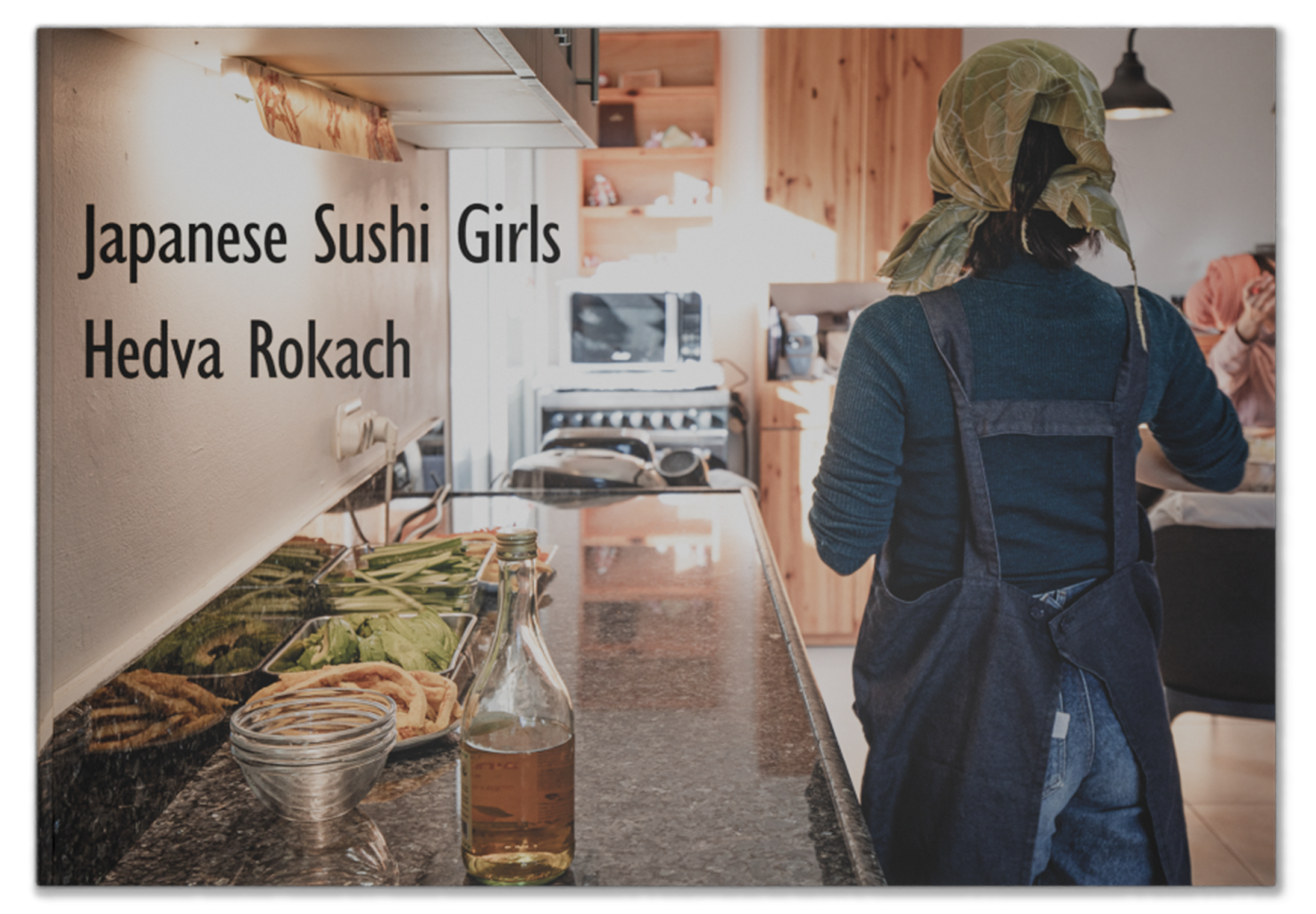
Japanese Sushi Girls is a narrative art photography book by Hedva Rokach, featuring 37 photographs that document an act of civilian solidarity during wartime.
Photographed in the immediate aftermath of the October 7th, 2023 attacks and the onset of the Gaza war, the project centers on six Japanese women living in Israel who prepared sushi for vegetarian and vegan soldiers. The images capture quiet moments of care, resilience, and cross-cultural empathy in a time of national crisis.
Photographed without staging, using natural light and real-life environments, the series preserves the authenticity and emotional depth of the moment. The project has been exhibited in solo shows at the Tikotin Museum of Japanese Art in Haifa (2024) and the Maine Jewish Museum in the United States (2025).
Rokach’s photography reveals intimate moments of women finding stillness within chaos.
— Ravit Danon, “On October 7, six Japanese women volunteered to prepare what they do best for the soldiers — food”, Haaretz, October 7, 2024
About the Book
Japanese Sushi Girls documents a quiet yet powerful human response to a national crisis. Instead of focusing on combat or destruction, the book highlights an intimate civilian act: cooking as a gesture of belonging, personal agency, and solidarity.
The six Japanese women featured in the project married Israelis, built their lives in Israel, and chose to stay during the war despite official evacuation options. Their decision reflects commitment, resilience, and cross-cultural connection.
Photographed without staging and using only natural light, the series captures movement, cooperation, and everyday ritual inside a small kitchen transformed into a meaningful social and cultural space. The book offers a visual resource for exploring art created in times of crisis, cross-cultural solidarity, migration, and contemporary narrative documentary photography.
About the Artist
Hedva Rokach is an Israeli art photographer specializing in narrative documentary work. She captures authentic moments without directing her subjects, using natural light and real-life environments. Her photographs have been featured in solo museum exhibitions in Israel, the United States, and Georgia. Rokach has published multiple art books, received international awards in London, Paris, Tokyo, and Budapest, and her work is included in both private and public collections worldwide.
At eight in the morning on Friday, January 19, 2024, Kaori, Naomi E., Yuri, Mami, and Eri arrived at Naomi S.’s home in Zichron Ya’akov. Together, the six ladies made sushi, a national dish of Japan and part of Japanese history and cultural heritage, for the soldiers on the front line.
For two hours, they layered rice on top of seaweed, then added cucumber, carrot, omelet, and other toppings, and chopped and wrapped the seaweed. While one lady wrote heartfelt words for the recipients of this personal present that touches many hearts, the other one packaged the sushi. The gesture was done to pamper people and provide them with food that these women are skillful in preparing, and make for their spouses and children; It was not just done to feed the hungry.
These moms and Japanese women gave their time, and their skills to the people of my nation, who became their people. I was charmed by their harmony and order when they were making the sushi. Their coordinated movements, their synchronization, the delicate finger acrobatics on top of the algae, the way they understood each other in silence, their laughter, and speech, their Japanese headcovers, and their ironed aprons were all very beautiful.
I found that purchasing sushi is increasingly popular in Japan; it seems that the traditional, sentimental process of preparing it is becoming rarely within time. In the short time we shared in the same home, I tried to capture in pictures the emotions, impressions, and awe I experienced.
Six ladies, six biographies, six life stories full of choices, aspirations, fears, hopes, and ambitions; each woman is an entire world. One of their choices was to move to Israel and live apart from their homeland, family, and parents. They decided to tie their fate to ours.
I want to express my sincere gratitude for all of these things, as well as to the family of Naomi S. who welcomed me into their home and let me witness the intimate harmony between these ladies. On their acts of kindness lies a fine thread of grace, generosity, and charm.
H.R.
Frequently Asked Questions
What is Japanese Sushi Girls?
A narrative art photography book documenting a civilian act of solidarity during wartime.
Who are the subjects?
Six Japanese women living in Israel.
What do the photographs show?
The preparation of sushi for vegetarian and vegan soldiers.
What defines the photographic approach?
Unstaged moments, natural light, and real-life environments.
Where has the work been exhibited?
At the Tikotin Museum of Japanese Art (Haifa) and the Maine Jewish Museum (USA).
Key Topics
Art created in times of war
Civilian acts of solidarity
Migration, identity, and belonging
Women and collective action
Food as a form of cultural expression
Narrative documentary photography
Cross-cultural connection