Transversals: Reverberations Across Contested Lines
Paula Gerstenblatt
מחיר קודם: $46
$33
Availability: In Stock
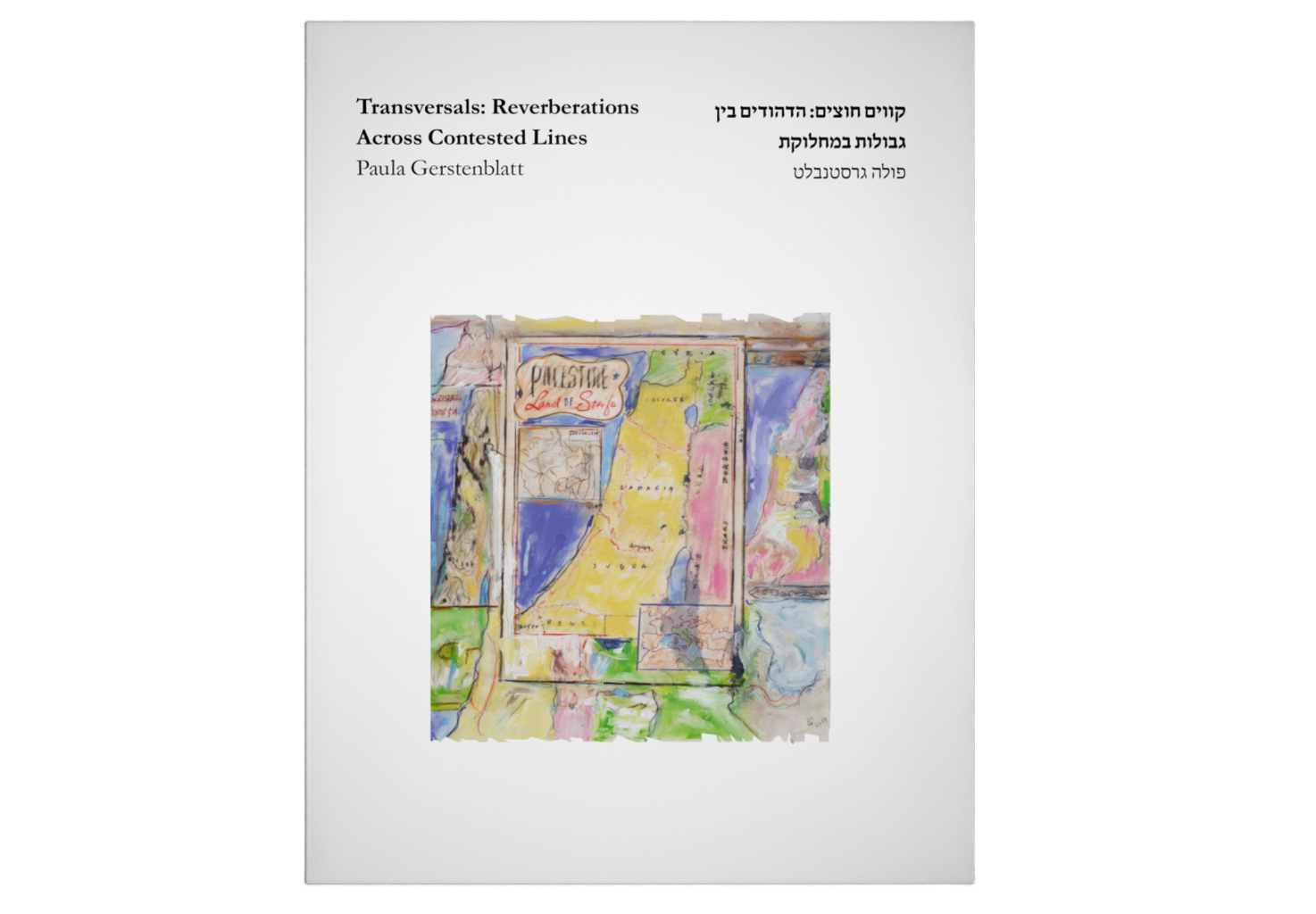
Transversals: Reverberations Across Contested Lines is the exhibition catalog for artist and scholar Dr. Paula Gerstenblatt’s 2026 exhibition at the Maine Jewish Museum. The book documents a body of work combining historic and contemporary maps, personal photographs, archival materials, collage, drawing, painting, text, and found objects. Moving between personal memory and collective history, Gerstenblatt explores borders, place, identity, memory, and changing perspectives on Israel and the Middle East. The catalog includes the artist’s statement, an essay by Jan Piribeck, an introduction by Louis Miller, and visual documentation of the exhibition.
Paula Gerstenblatt’s use of maps and archival documents combined with her personal iconography creates a space where borders shift and time is fluid
— Jan Piribeck
About the Book
Transversals: Reverberations Across Contested Lines accompanies Paula Gerstenblatt’s 2026 exhibition at the Maine Jewish Museum.
The book presents a body of work shaped by personal experience, historical research, and sustained engagement with Israel and the Middle East. Gerstenblatt examines how borders, maps, memories, and narratives change when viewed from different perspectives. Rather than attempting to provide a comprehensive account of the region or represent every side of its conflicts, she brings together different layers of information, memory, and experience to explore how personal and collective narratives shape one another.
The works combine maps from the Ottoman period to the present, archival materials, family photographs, text and poetry, drawings, collages, paintings, and personal artifacts. Layers of Mylar, colored pencils, oil bars, pastels, and pigment sticks allow Gerstenblatt to reorient maps, connect different places and periods, and construct nonlinear narratives.
Memory and place are central to the work. Among the personal materials incorporated into the exhibition are her mother’s journal and photo album from a 1992 trip to Israel, photographs of Gerstenblatt and her daughter in Jerusalem in 1998, objects preserved for decades, and Jerusalem Post newspapers documenting Egyptian President Anwar Sadat’s 1977 visit to Jerusalem. These personal traces are placed alongside a much longer history of conquest, resistance, empires, religious conflict, exile, changing borders, and competing territorial claims.
A recurring idea throughout Transversals is the map not simply as a neutral representation of geography, but as a document that tells a story, preserves memory, and reflects human choices. By bringing together maps from different periods and sources, Gerstenblatt invites viewers to reconsider borders, territory, identity, and perspective.
The catalog also includes an essay by artist and Professor Emerita Jan Piribeck, who examines Gerstenblatt’s use of maps, archival materials, layering, repetition, and personal iconography. An introduction by Louis Miller of the University of Southern Maine’s Osher Map Library and Smith Center for Cartographic Education considers the exhibition as an archival space in which viewers are invited to investigate, interpret, and draw their own conclusions.
In this sense, Transversals functions both as an art book and as a visual research document: a record of an exhibition, a personal journey through memory and history, and an encounter between art, cartography, archival materials, and narratives of place.
About the Artist
Paula Gerstenblatt is an artist and Professor in the School of Social Work at the University of Southern Maine. Her academic and artistic work includes community art practice, arts-based research, and explorations of the relationship between individual narratives, communities, and social, political, cultural, and ecological change.
Gerstenblatt works across painting, drawing, and collage. Her practice frequently examines how individual stories anchor collective narratives and how larger histories shape personal experience.
She has received two National Endowment for the Arts grants, along with additional foundation and humanities awards for her arts-based community work. Her work has been exhibited in the San Francisco Bay Area and Maine, including at the Maine Jewish Museum, LC Bates Museum, and Holocaust and Human Rights Center of Maine.
Frequently Asked Questions
What is Transversals: Reverberations Across Contested Lines about?
It is the catalog of Paula Gerstenblatt’s exhibition at the Maine Jewish Museum. The book explores Israel and the Middle East through maps, personal photographs, archival materials, collage, drawing, painting, and text, with a focus on borders, memory, identity, and changing perspectives.
What makes Paula Gerstenblatt’s work distinctive?
Gerstenblatt combines historical research and archival materials with personal memories, photographs, and objects. Rather than using maps simply to represent geography, she transforms them into artistic materials and uses them to investigate how memory and narrative shape our understanding of place and history.
What materials are featured in the book?
The catalog documents works incorporating historic and contemporary maps, family photographs, archival documents, newspapers, Mylar, colored pencils, oil bars, pastels, pigment sticks, drawings, collages, paintings, and personal artifacts.
How does the artist’s personal history connect to the history of the region?
Gerstenblatt has returned to Israel over several decades, and places and historical moments in the region are closely connected to different phases of her life. The book brings together photographs, journals, and family artifacts with historical events, including Anwar Sadat’s 1977 visit to Jerusalem.
Does the book present a single political position?
The book does not attempt to represent every side or provide a comprehensive political account. It presents Gerstenblatt’s personal and artistic perspective while bringing together different maps, sources, and narratives to examine complexity and encourage dialogue and interpretation.
Key Topics
Historic and contemporary maps of Israel and the Middle East
Borders, territory, and contested spaces
Personal and collective memory
History, archives, and narrative
Israel and the Middle East
Arts-based research
Cartography as storytelling and interpretation
Family photographs and personal artifacts
Layering, collage, and nonlinear narratives
Anwar Sadat’s 1977 visit to Jerusalem
Past and present
Identity, place, and belonging
Hope, loss, and complexity
Personal experience and collective history