Intersecting Ecologies
Paula Gerstenblatt and Jan Piribeck
מחיר קודם: $43
$26
Availability: Out of Stock
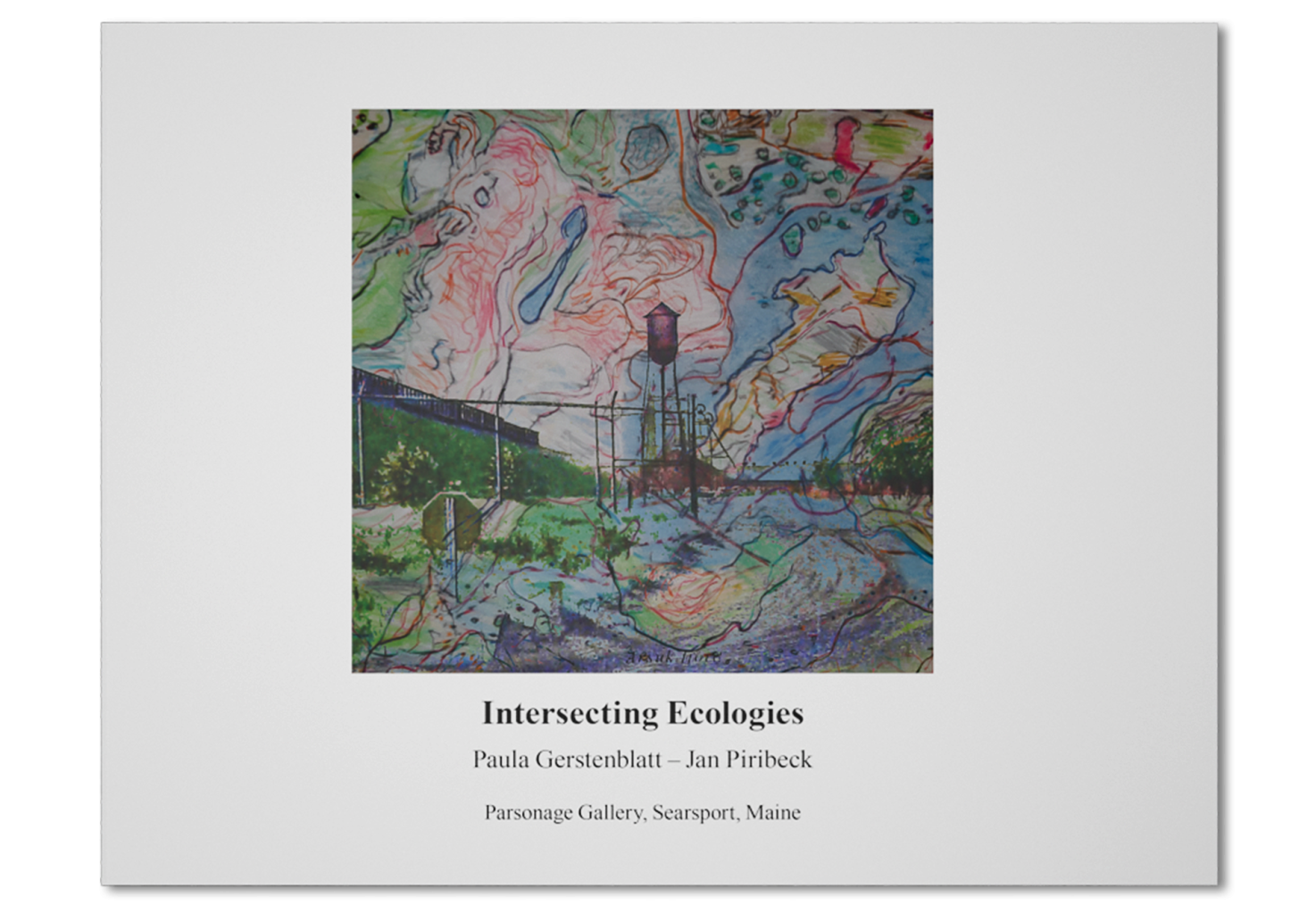
Intersecting Ecologies is a two-artist exhibition catalog by Paula Gerstenblatt and Jan Piribeck, documenting a site-specific, interdisciplinary art project presented at the Parsonage Gallery in Searsport, Maine, USA. The project explores the intersection of personal, social, and environmental ecologies across three island sites: Long Island and Sears Island in Maine, and South Greenland. The catalog features a joint artist statement, a foreword by curator Aaron Rosen, and selected works from the exhibition. It is an essential reference for those interested in art, climate change, and community-based creative practice
Together, Paula Gerstenblatt and Jan Piribeck are a force, and it has been a pleasure to watch their illuminating collaboration come to life.
— Aaron Rosen, Director of the Parsonage Gallery
About the Book
Intersecting Ecologies presents an interdisciplinary project that blends visual art, qualitative research, and community engagement. Focusing on island environments in Maine and South Greenland, the book explores how environmental change intersects with social systems and personal experience.
More than just an exhibition catalog, it serves as a resource for understanding how art can communicate the climate crisis, highlight overlooked voices, and encourage collective reflection. Through walking practices, collage workshops, painting, drawing, and digital media, the artists craft layered narratives grounded in place, memory, and material.
This book will appeal to scholars, artists, and curators interested in environmental humanities, socially engaged art, and the ways creative practice intersects with ecological and social concerns.
About the Artists
Jan Piribeck is an artist and Emerita Professor of Art at the University of Southern Maine. Her work investigates how art can communicate the climate crisis and inspire social change. Combining painting, drawing, digital media, and community-based walking practices, she has exhibited her work nationally and internationally.
Dr. Paula Gerstenblatt is an artist and Professor of Social Work at the University of Southern Maine. Her research and studio practice explore environmental, cultural, and social change in coastal communities through qualitative and arts-based methods. A recipient of a National Endowment for the Arts grant, her work has been widely shown across the U.S. and abroad.
Forward
The Intersecting Ecologies exhibition is about energy. On the one hand, it is an exploration of the unintended consequences that occur when people look to explore—and in many cases, exploit—natural resources to satiate their appetite for power. Just as importantly, however, this is an exhibition that buzzes with creative energy. It is a testament to the electricity that can be generated when two artists pursue a shared vision, with just the right amount of friction along the way. Together, Paula Gerstenblatt and Jan Piribeck are a force, and it has been a pleasure to watch their illuminating collaboration come to life.
The exhibition represents the culmination of years of collaborative research, artistic output and community-engaged practice by Gerstenblatt and Piribeck in a range of coastal settings, from Greenland to Maine. Their work is based on exploring the interplay between internal processing systems and the external flow of information. This creates a space where diverging views and processes can remain distinct and productively collide. The diverse use of materials, textures, and media make tangible the complexity of the themes, experiences, and perspectives expressed by the artists in ways that integrate fragments and layers into a cohesive whole. It was apparent throughout their research and creative process how well the artistic duo has learned to navigate ambiguity and complexity in tandem over time.
Their work is influenced by the Deep Ecology movement, and a shift away from anthropocentrism, which sees humans as the most important beings, to ecocentrism, where all life forms have inherent value. Animated by this philosophical perspective, the artists emphasize interdependence and impermanence in the systems–both environmental and cultural–which they study.
The Parsonage Gallery is proud to present the Intersecting Ecologies exhibition and related public programming. As both have revealed, the ‘value’ of natural ecosystems are rhetorically constructed and reconstructed over time. We need to take a long view of ecology and discourse itself. Doing this properly requires a serious investment of energy, both creative and intellectual. And we are fortunate to have in these artists two expert guides.
Aaron Rosen
Director of the Parsonage Gallery
Artists’ Statement: Gerstenblatt – Piribeck
We are honored to show our work in the context of the Parsonage Gallery’s mission, which is to explore the intersection of spirituality, ecology, and creativity.
This exhibition focuses on the intersection between personal, social, and environmental ecologies. The geographic locations represented in the work are Long and Sears Islands in Maine and South Greenland, where we worked as researchers, community practitioners, and artists. Our aim in producing this work was to illuminate the complexity of relationships between humans and their physical surroundings, including the plant and animal world. The exhibition itself is considered a collage/montage of two artists’ work exploring themes of interdependency and autonomy, conservation and industrial development, impermanence, and the constant state of flux we sometimes rebel against, yearning to hold on to what slips through our fingers despite our tightened grip.
The work in the exhibit combines physical materials, digital media, and found objects. The installation includes interrelated 2-D collages/montages plus 3-D and time-based elements, some of which were created individually and others collaboratively. Both artists incorporate juxtaposition, layering, blending, and interaction of text & image to create non-linear narratives, Gerstenblatt weaving fragments to a whole and Piribeck distilling elements to their essence.
When we collaborated on work for the show we blended our distinct attitudes, styles, and processes, which involved communication, conflict, negotiation, and respect. This co-creating process pushed the margins for us as artists and friends, compelling us to acknowledge our differences, play to our strengths, and relinquish control with trust and confidence in our shared vision. Through this, we learned more about ourselves as artists, acquired new ways of creating and appreciating different perspectives and possibilities, which we will carry forward in our individual and collective work.
By weaving together the personal, social, and environmental, we explore what it means to be connected–to the past, present, and future. There is a play between internal neurological systems and external information systems, and between the ephemeral and physical touch. This fusion creates a kind of collision with what made us who we are. In Gerstenblatt’s case, being raised by activist parents during the turbulence of the Vietnam War and Civil Rights movement, the impact of early and continued loss, and an innate attraction to nature and creating art since childhood. For Piribeck, being a coal miner’s daughter growing up in a town dominated by the mines instilled an appreciation of labor issues and concern for the environment, which propelled her to unite art with social and environmental activism. Artistic influences such as collage, expressionism, conceptual art, and minimalism also influenced our outlook and ultimately the work of this exhibition, as did the philosophical perspective of the Deep Ecology movement.
This exhibition evolved from Maine-Greenland Collaborations, an interdisciplinary project that led us to these three islands. The process of doing relational and reciprocal work deepened our understanding and connection, which will undoubtedly influence future work, individually or collaboratively. This process for us as artists and friends has enriched our relationship and expanded our reference base and possibilities for the future.
Acknowledgements
We thank the Onion Foundation and the Maine North Atlantic Institute of the University of Southern Maine for their financial support of Intersecting Ecologies and extend our gratitude to the Friends of Sears Island for partnering with us on the project. We also wish to acknowledge the Industries Program at the Maine Correctional Center, Zero Station in Portland for lending their technical expertise in the development of work for the show, and Hedva Rokach and Itay Bahur for their aesthetic and technical support in the production of photographic images and this catalog.
Frequently Asked Questions
What is Intersecting Ecologies?
An exhibition catalog documenting a collaborative art and research project.
What is the focus of the project?
Exploring the intersections of environmental, social, and personal ecologies.
Where did the project take place?
On islands in Maine, USA, and South Greenland.
What artistic methods are used?
Painting, drawing, collage, digital media, and community-based practices.
Who is the catalog for?
Researchers, artists, curators, and audiences interested in environmental humanities and socially engaged art.
Key Topics
Art and the climate crisis
Social and environmental ecologies
Place-based art practices
Community-engaged research
Island landscapes and environments
Environmental humanities
Art as a catalyst for social change